



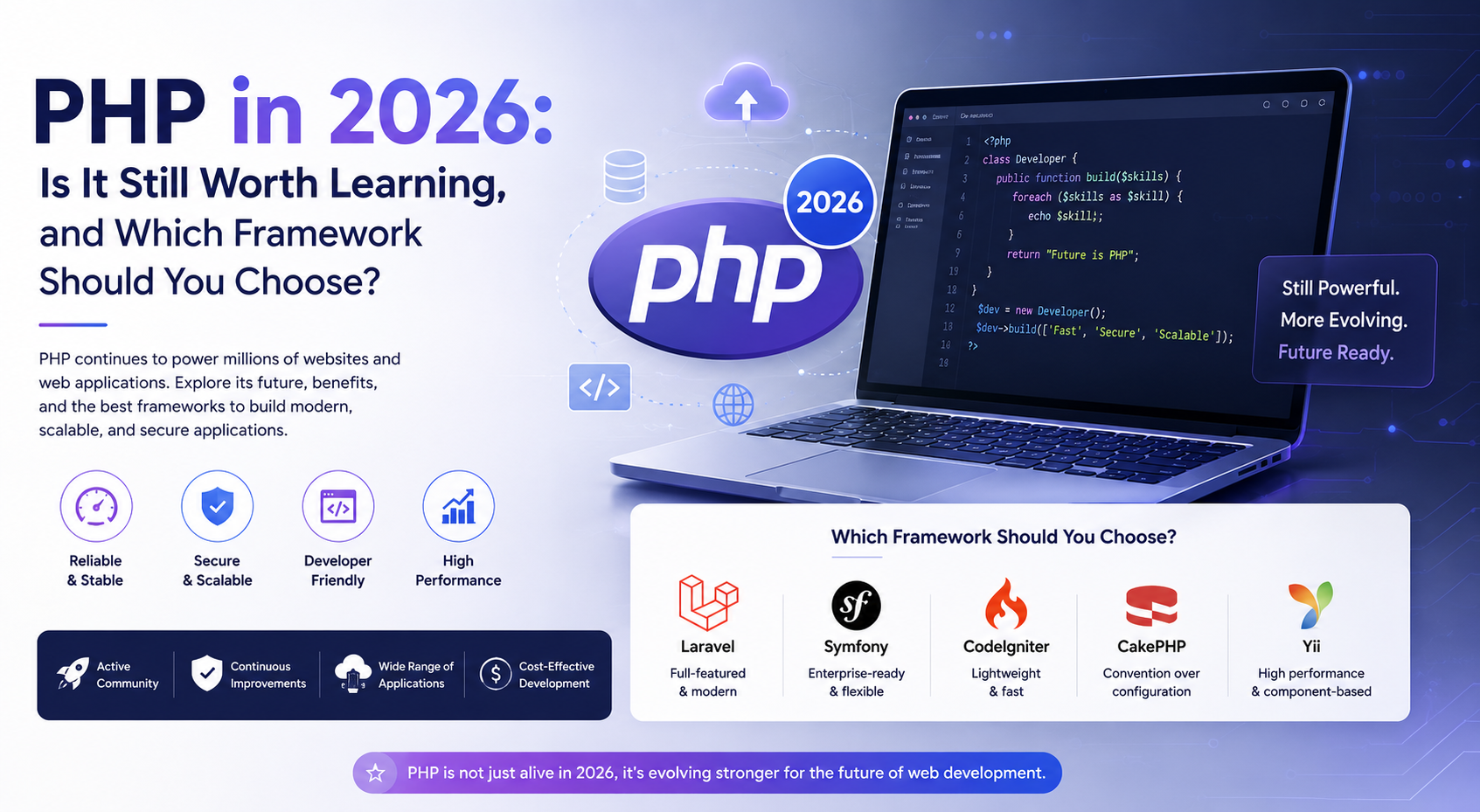
PHP in 2026: Is It Still Worth Learning, and Which Framework Should You Choose?
PHP powers a large share of the web, and modern PHP looks nothing like the language’s reputation from a decade ago. If you’re deciding whether to learn it, or which framework to build on, here’s a practical rundown.
Why PHP is still relevant
PHP has quietly modernized. Recent versions brought a JIT compiler, strong typing options, enums, readonly properties, and fibers for concurrency — features that put it much closer to modern typed languages than the PHP most developers remember. It also still runs a huge share of the web, including WordPress, which alone accounts for a significant portion of all websites.
The practical case for PHP in 2026 comes down to a few things:
- Deployment is simple. Shared hosting, a VPS, or a container — PHP runs almost anywhere without exotic infrastructure.
- The ecosystem is mature. Composer (PHP’s package manager) and Packagist give you a dependency ecosystem on par with npm or pip.
- Hiring is easier than you’d think. PHP remains one of the most widely known server-side languages, which matters when a team needs to grow.

The major PHP frameworks
Laravel
Laravel is the dominant choice for new PHP projects, and for good reason — it’s opinionated in a way that gets you moving fast: routing, an ORM (Eloquent), authentication scaffolding, queues, and a templating engine (Blade) all come built in.
Good for: SaaS products, APIs, and full-stack apps where you want batteries-included conventions and a huge ecosystem of packages (Laravel Forge, Nova, Sanctum) to lean on.
Symfony
Symfony takes a more modular, enterprise-oriented approach — you can use as much or as little of it as you need, and many of its components (including parts of the HTTP layer) are used inside Laravel itself. It has a steeper learning curve but offers more architectural control.
Good for: Large, long-lived applications where flexibility and strict architecture matter more than getting a prototype out the door quickly.
CodeIgniter
CodeIgniter is the lightweight option — minimal overhead, a small footprint, and a gentle learning curve. It doesn’t come with as many conventions or built-in features as Laravel or Symfony.
Good for: Smaller applications, or teams that want fine-grained control without a large framework’s opinions getting in the way.
Comments are closed