


The Modern Python Toolkit: What’s Actually Worth Learning in 2026
Discover why Python is the world’s most popular programming language for AI, machine learning, automation, and web development.
Python has become the most versatile programming language, powering everything from artificial intelligence and automation to web applications and data analytics.
From AI to automation, Python turns complex ideas into intelligent solutions.
Netstaffle Technologies
Web Development
FastAPI has become the default choice for building APIs. It’s built on type hints, generates interactive docs automatically, and is async-native, which makes it fast without extra effort.
Django is still the heavyweight for full applications — admin panel, ORM, auth, and templating all included. If you’re building something with a database-backed backend and don’t want to assemble it from parts, Django remains a strong choice.
Flask sits in between: lightweight and unopinionated, good for smaller services or when you want full control over your stack.
Data & Analytics
Pandas is still the backbone of tabular data work, though Polars has emerged as a genuinely faster alternative — it’s written in Rust, uses lazy evaluation, and handles larger-than-memory datasets more gracefully.
DuckDB deserves a mention here too: an embedded analytical database that lets you run SQL directly against Pandas or Polars dataframes, CSVs, or Parquet files with no server setup.
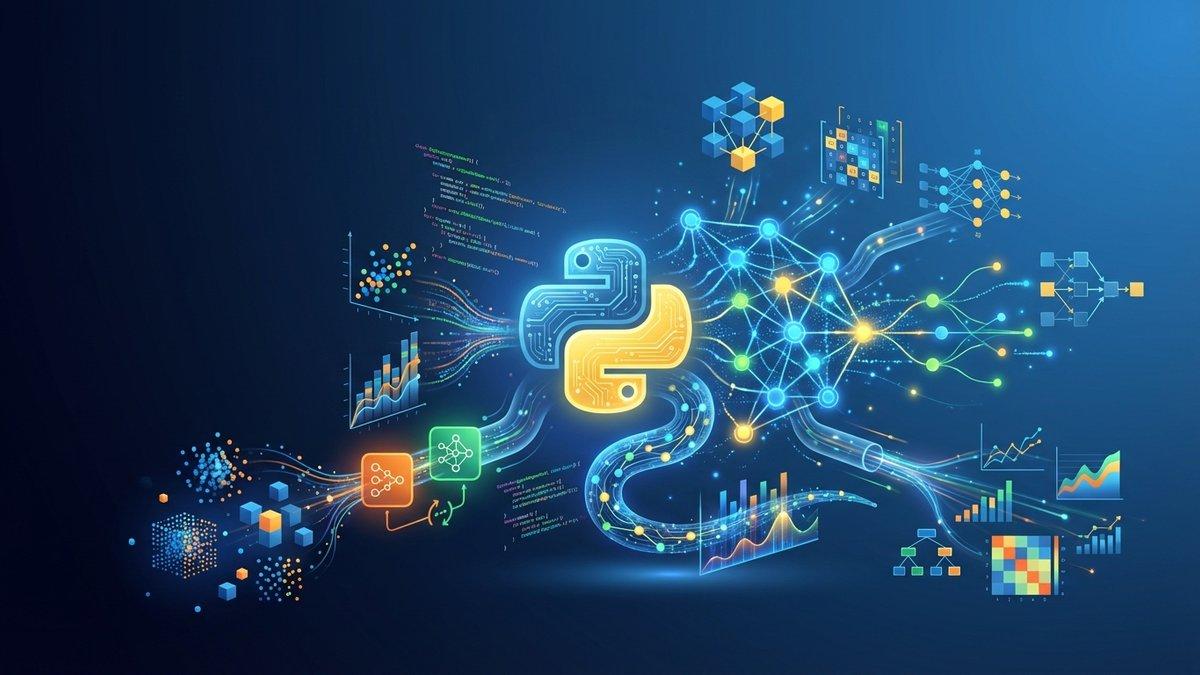
Machine Learning & AI
PyTorch has won the research and production battle over TensorFlow for most new projects — the ecosystem (Hugging Face Transformers, Lightning, etc.) is built around it.
scikit-learn remains the right tool for classical ML — regression, clustering, tree-based models — where you don’t need a neural network.
For anyone building on top of LLMs, LangChain and LlamaIndex provide orchestration layers, while the Anthropic and OpenAI Python SDKs are usually the simplest path if you just need direct API access without extra abstraction.